Semi-Verbal vs Nonverbal Autism: A Guide for Your Village
Understanding Communication Differences and Finding Their Voice
Disclaimer: As an Amazon Associate I earn from qualifying purchases. This helps support the work we do for our Village!
More Than Just Talking
In Our Autism Village, we know that communication is so much more than just spoken words. It’s about connection, understanding, and making sure every child’s voice—however they express it—is heard. For many parents, the journey to understand their child’s unique way of communicating can feel overwhelming.
You might have a child who uses a few words, or one who doesn’t speak at all, or perhaps one who speaks but struggles to be understood. Maybe you’re like us and have been in speech therapy for over a decade.
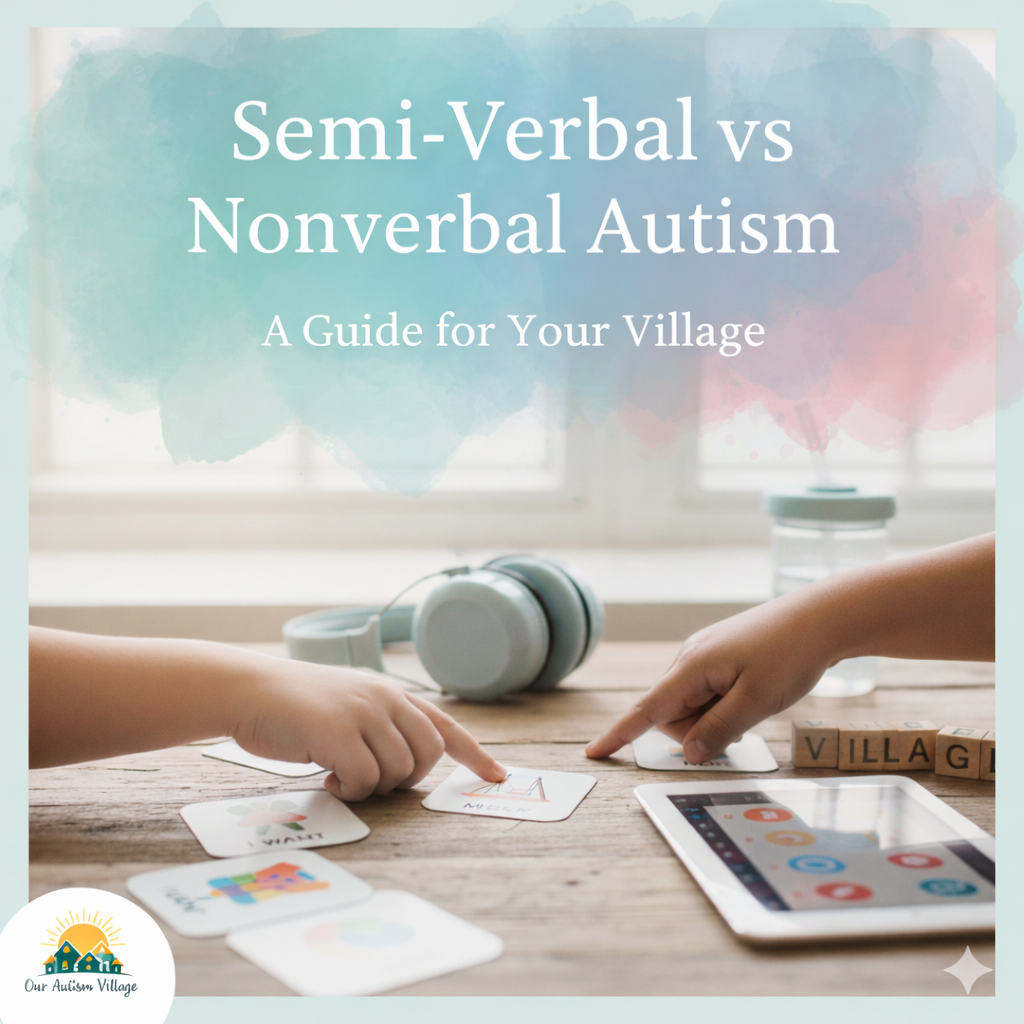
Today, we’re unpacking what it means to be semi-verbal vs nonverbal and how we can best support our children in finding their way to express themselves.
Defining Semi-Verbal vs Nonverbal
Let’s start by clarifying some terms that are often used interchangeably, but have distinct meanings in the world of autism and communication:
- Nonverbal: A nonverbal child primarily communicates without spoken words. This doesn’t mean they can’t communicate or don’t have anything to say. It simply means their primary method of expression isn’t verbal language. They might use gestures, facial expressions, body language, vocalizations, or augmentative and alternative communication (AAC) systems like picture exchange (PECS), sign language, or communication devices.
- Village Note: Being nonverbal is not a reflection of a child’s intelligence or desire to connect. It means we, as their village, need to adapt our communication to meet them where they are.
- Semi-Verbal: A semi-verbal child uses some spoken words, phrases, or simple sentences to communicate, but their verbal language isn’t fully conversational or consistent. They may use language primarily for specific purposes, such as expressing immediate wants and needs, labeling objects, or repeating phrases, which is known as echolalia.
- L’s Journey: In our home, my son L started his communication journey as primarily nonverbal. For a long time, we relied on gestures and careful observation. Over time, with consistent support, therapy, and patience, L has become semi-verbal. At 5 years old, he was finally using two-word phrases like, “want cup” or “get milk.” He has gradually gained more language over the years. Today, he uses simple sentences to express his wants and needs, like “I want the book,” “I don’t want to,” or “Can I have it?” While he’s not conversational in the typical sense, these spoken words are huge victories that unlock his world and allow him to participate more fully in our family life. Even at 16, he continues to progress in language development (albeit slowly). His journey reminds us that progress looks different for everyone, and every word is a bridge.
Beyond Labels: The Full Spectrum of Communication
It’s also important to remember that communication is a spectrum. Even fully verbal children can have communication differences.
- N’s Articulation Challenge: My 18-year-old son N is a great example of this. He is conversational and can string together complex thoughts and stories. However, N struggled with articulation growing up, meaning his speech sounds could be unclear to others outside our immediate family. This was frustrating for him as he tried to be understood. He’s come a long way since then but can still stutter over his words as he gathers his thoughts. I have to tell him to slow down and think about what he is going to say first. While his language difficulties looked vastly different from L’s, the core need is the same: to be understood and to connect.
- Village Note: For children like N, clear articulation isn’t about intelligence either; it’s about the motor planning for speech. Our role is to listen patiently, seek clarification gently, and ensure they have strategies to bridge the gap when needed.
Why Understanding Matters in Our Village
Understanding these differences isn’t just about definitions; it’s about empowerment. When we know how our children communicate, we can:
- Reduce frustration for everyone.
- Provide appropriate tools and support, like therapy and communication devices.
- Celebrate every step of their unique communication journey.
- Build stronger, more connected relationships within our families and our wider “Village.”
In the coming weeks, we’ll dive deeper into practical strategies for supporting semi-verbal and nonverbal communicators, including tips on AAC, visual schedules, and creating communication-rich environments.
Do you have a communication story? Share it in the comments below!
“Your pace is the right pace.” – Our Autism Village
Featured Village Resource

Our $7 Monthly Pass
Ongoing Village Support. A fresh digital resource delivered every month to keep your advocacy folder updated and your stress levels low. Subscribe today for an Instant Digital Freebie!