Autism Story: The Day I Gave Up “Normal”
Disclosure: This post contains affiliate links. As an Amazon Associate, I earn from qualifying purchases at no additional cost to you. I only recommend products we have personally used in our journey with DMDD and autism.

They say, “If you’ve met one person with autism, you’ve met one person with autism.”
It’s a cliché for a reason. It implies that every experience on the spectrum is varied, complex, and deeply individual. In my home, that truth lives in the contrast between my two sons, N and L.
By 2018, autism was already a familiar friend. N was 11 and L was 9. We had been on this journey for years. N is what used to be called “Asperger’s” or “high-functioning.” Today, at nearly 19, he’d likely be classified as Level 1—low support needs, highly verbal, but still navigating the social friction that comes with the spectrum.
But our journey with L hasn’t looked anything like the one we had with N.
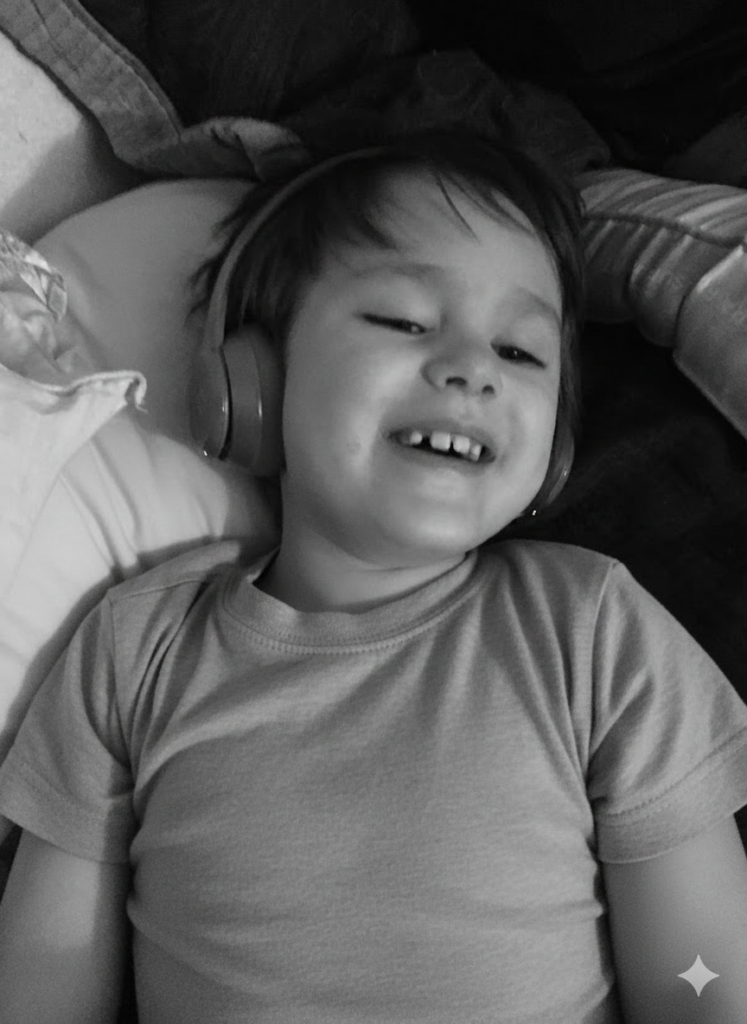
L is semi-verbal with significant communication and cognitive impairments. He navigates a complex cocktail of autism, ADHD, sensory processing disorder, insomnia, intellectual disability, and a mood disorder called DMDD (Disruptive Mood Dysregulation Disorder). He is 16 now, but he communicates with the world much like a three-year-old would. He loves ABCs, SpongeBob, and Mario. He remains incredibly innocent to all the bad in the world.
When L was in kindergarten, I remember overhearing another boy tell his mom at parent pickup that L was “crazy.” I’m only thankful that my boy doesn’t understand what that means. I’m sad that the parent didn’t tell her son that everyone is different and we shouldn’t call people “crazy.” As a teacher, I see first-hand how many kids aren’t taught this lesson.
The Myth of “Normal”
I’m going to be incredibly vulnerable here in my autism story: I have let autism defeat me a time or two. When the boys were young, the world felt manageable. We still did the “normal” things—restaurants, parks, shopping trips, family events. As L grew older and his sensory needs intensified, it got harder. But I kept pushing. I told myself the boys needed to learn how to survive in a world full of people who didn’t understand them.
Then came the day I finally gave up on “normal.” I remember it like it was yesterday.
The Breaking Point
It was the last week of October 2018. The boys’ elementary school was hosting a carnival. For the first hour, L did great, in large thanks to his noise canceling headphones. But as the sun dipped below the horizon, the crowds arrived in droves. The lines grew long; the lights grew piercingly bright against the dark.
L lost it. He stood in line screaming and crying. I stayed by his side, softly encouraging him to be patient, desperate to make the “normal” outing work. Then, the ultimate humiliation: he pooped his pants, right there at the carnival. He had been potty trained for five years. I truly believe his body simply shut down under the weight of the overstimulation.
We took him home. Once he was back in the quiet, back in his “zone,” the screaming stopped. I stared at him and saw the immediate, peaceful smile return to his face.
I told myself that day I would stop pushing “normal” on him.
But I didn’t stop. Not yet.
The Final Lesson
A few nights later, I tried again with trick-or-treating.
Is there a word stronger than “disaster”? “Catastrophe,” perhaps? It was awful. L couldn’t grasp that every house had different rules. He would get upset when he wasn’t allowed to walk right into a stranger’s home. He didn’t understand why people would yank their candy buckets away when he tried to grab a piece—they were just trying to follow the “rule” of handing it out, but to L, it felt like a rejection when the previous house allowed him to pick.
Other children stared as he cried and screamed, overwhelmed by the flashing lights and the unpredictable noise.
Somewhere along that sidewalk, I got tired. I got tired of explaining autism to strangers. I got tired of apologizing for my son’s existence. Damn it, I thought, why can’t people be more tolerant? But more importantly, I asked myself a question that changed everything:
If my boy is so happy in his zone, why am I pulling him out of it just to make us both miserable?
Choosing Peace Over “Proving”
Since that night, our world has shrunk in size, but it has grown in peace. I stopped trying to prove that we could “handle” the carnival or the crowded restaurant. Instead, we started building a life that fits L, rather than forcing L to fit a world that wasn’t built for him.
Today, our “normal” might look like a quiet night at home while the rest of the neighborhood is at a festival. It might mean skipping the big family gathering if the sensory load is too high. It means I don’t apologize as much anymore. I’ve realized that my job isn’t to toughen him up for a world that lacks empathy; it’s to be the gatekeeper of his happiness.
L is 16 now, and he is still most beautiful when he is in his zone. I finally realized that “giving up” on normal wasn’t a defeat at all—it was the greatest gift I could ever give my son. It was the day I stopped choosing the world, and started choosing him.
Do you have a personal story to share? If you’re comfortable, I’d love to hear it and possibly feature it on a future blog. Get in touch with me via our contact form.
Have you registered? Registered members receive exclusive access to members-only content, forums, downloads, and more.