Autism School Refusal: Dealing with the Post-COVID “Optional” Mindset
Disclosure: This post contains affiliate links. If you click through and make a purchase, I may earn a small commission at no extra cost to you. This helps support the Village!
It has been 4 solid years since schools have been in session full-time. The COVID period may seem like a distant memory for some.
Not for this autism family.
My oldest autistic son, N, did wonderfully during the pandemic. He logged in each day and participated in his “distance learning” sessions for hours with minimal support from us.
However, our son, L, has profound autism. He was only capable of logging in to wave and say “hi” to his teacher. Due to this, he was one of the first groups that was able to return back to his school full-time.
But the damage had been done. L learned that actually going to school was optional, and he hasn’t forgotten.
Every morning, the same battle plays out in our home. L, who once embraced going to school with enthusiasm, now shouts, “No school!” over and over again. This isn’t a phase; it has been this way for over four years. Ever since COVID taught him that “school” was as simple as a two-minute virtual check-in with his teacher.
The “COVID Lesson”: When the Rules Became Optional
For many autistic individuals, the world operates on a set of logical, consistent rules. And for a year, a huge, undeniable rule was broken: school is mandatory.
From my son’s perspective, the logic was undeniable:
- Rule 1 (Pre-COVID): School happens five days a week, no exceptions.
- Rule 2 (During COVID): School doesn’t happen five days a week; we try to learn from home for a few minutes. Life continued, the world didn’t end.
- His Conclusion (Post-COVID): Therefore, school is, in fact, optional. The precedent was set.
Now, every morning, he’s not just refusing; he’s logically asserting a “truth” that was reinforced for over a year. It’s not defiance; it’s a deep-seated belief system that we are now constantly trying to re-wire. The fight isn’t because he’s being difficult; it’s because his world changed, and he’s still trying to make sense of the “new” rules. And believe me, as a parent and special education teacher, I know how utterly exhausting this battle can be.
Navigating the Morning Battle: Strategies From Our Village
Overcoming this “COVID hangover” hasn’t been easy, but through trial and error, we’ve developed some strategies that are slowly, slowly helping. If you’re currently in the trenches of daily school refusal, I hope these insights bring you some peace and a plan.
1. The Power of “What’s Next” (The Future-Focus)
Autistic children often struggle with the abstract concept of “future rewards” or simply can get stuck in the overwhelming “now” of anxiety. We’ve found that giving my son something specific to look forward to, even if it’s days away, can be a powerful motivator.
- Tip: Explicitly remind him/her of upcoming events. “Remember, it’s a short week because of the school break on Friday!” or “We get to visit Grandma’s house this weekend!” Even mentioning a favorite after-school activity or a special treat on the calendar can provide a bridge over the morning’s immediate discomfort.
- The “Why”: It helps shift his focus from the current struggle to a positive future event, giving him a concrete reason to push through the present.
2. Consistency Over Comfort
This is often the hardest part because it feels counter-intuitive to our loving instincts. When your child is distressed, the natural urge is to comfort and, sometimes, to give in. However, for a child who has decided “school is optional,” any deviation from the routine reinforces that belief.
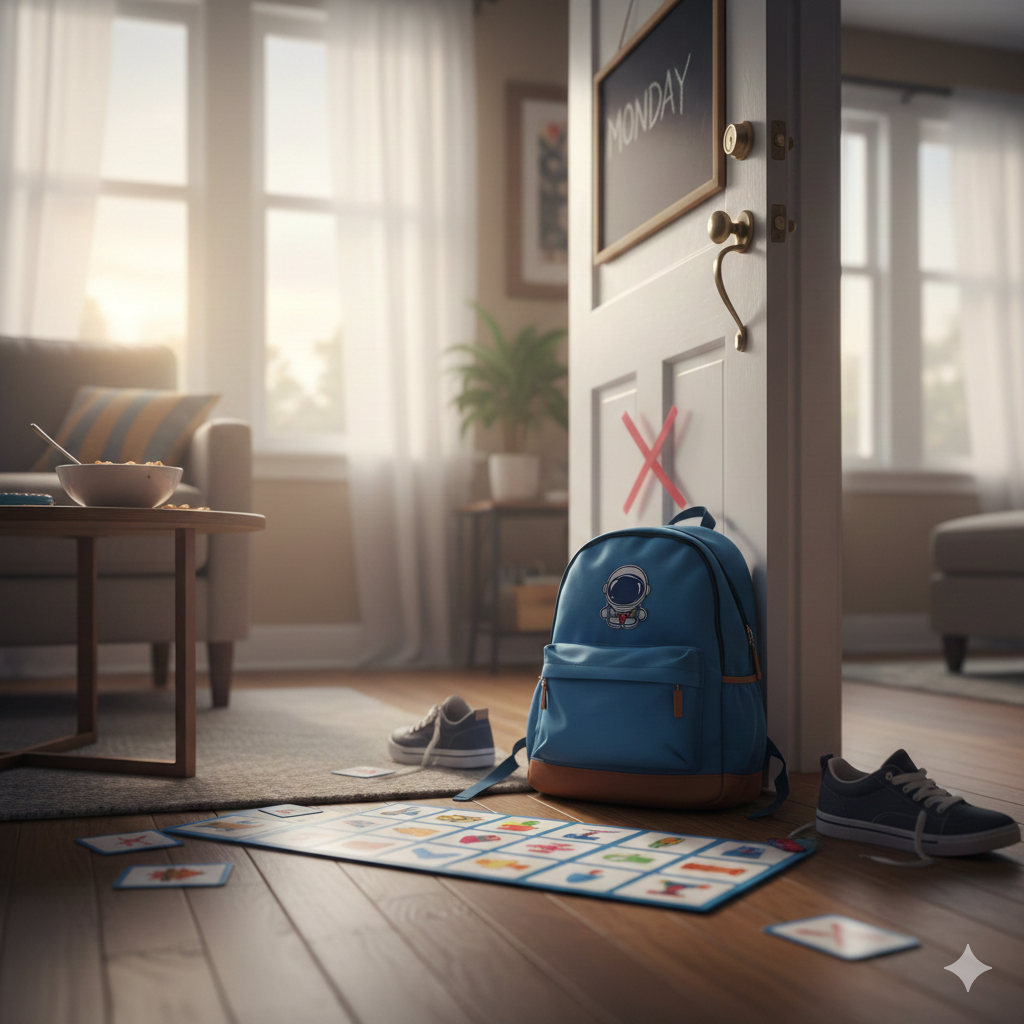
- Tip: Maintain a rigid, sensory-friendly morning routine every single day. From breakfast to getting dressed—keep the order of morning tasks exactly the same. Even if there’s pushback, gently but firmly guide your child through each step.
- The “Why”: Predictability reduces anxiety. When the routine itself is consistent, it leaves less room for the “optional” idea to creep in. Your consistency communicates, louder than words, that the rule of “going to school” is back.
3. Bridging the Gap: Connecting Home to School
Often, once they get to school, our kids are “fine.” Teachers report no issues, and they participate as usual. The struggle is purely the transition. Since my son performs well once he’s there, we leverage that.
- Tip: Implement a “transitional object” or a specific “school-only” reward. This could be a favorite fidget toy that only comes out when he’s at school, a special pencil he uses only in class, or even a small, pre-arranged treat he gets after he’s walked into the classroom.
- The “Why”: It creates a tangible link between home and school, and it provides an immediate positive reinforcement that is only accessible once the “school boundary” has been crossed.
You Are Not Alone in This Fight
The post-COVID era has brought unexpected challenges, and for parents of autistic children, the “school is optional” mindset is a very real, very exhausting struggle. Remember that your child isn’t doing this to spite you; they are responding to a logical shift in their world that was profoundly impactful.
Keep offering consistency, keep reminding them of the good things to come, and most importantly, remember that you are doing an incredible job navigating a landscape no one prepared us for.
If your family is still dealing with post-COVID school refusal, let us know how you handle it in your own home in the comments!
Disclaimer: I am a Special Education Teacher and a parent, but I am not a doctor, psychiatrist, or licensed medical professional. The information on this website is for educational and informational purposes only and is not a substitute for professional medical advice, diagnosis, or treatment. Always seek the advice of your physician or other qualified health provider with any questions you may have regarding a medical condition.
Featured Resources
The Monthly Pass
Ongoing Village Support. A fresh resource delivered every month to keep your advocacy folder updated and your stress levels low.
The IEP Advocacy Toolkit
The Foundation. Our signature 20-page PDF guide for IEP/504 success. Launching 02/15/2026 straight to your inbox. Pre-Order to save $5 today!